How to Practice Language Dictation with Audio on Mac
Practice dictation from a short language recording: listen and write first, then compare with a reviewed transcript or a clearly labelled speech-recognition draft.
2026-10-04 · 7 min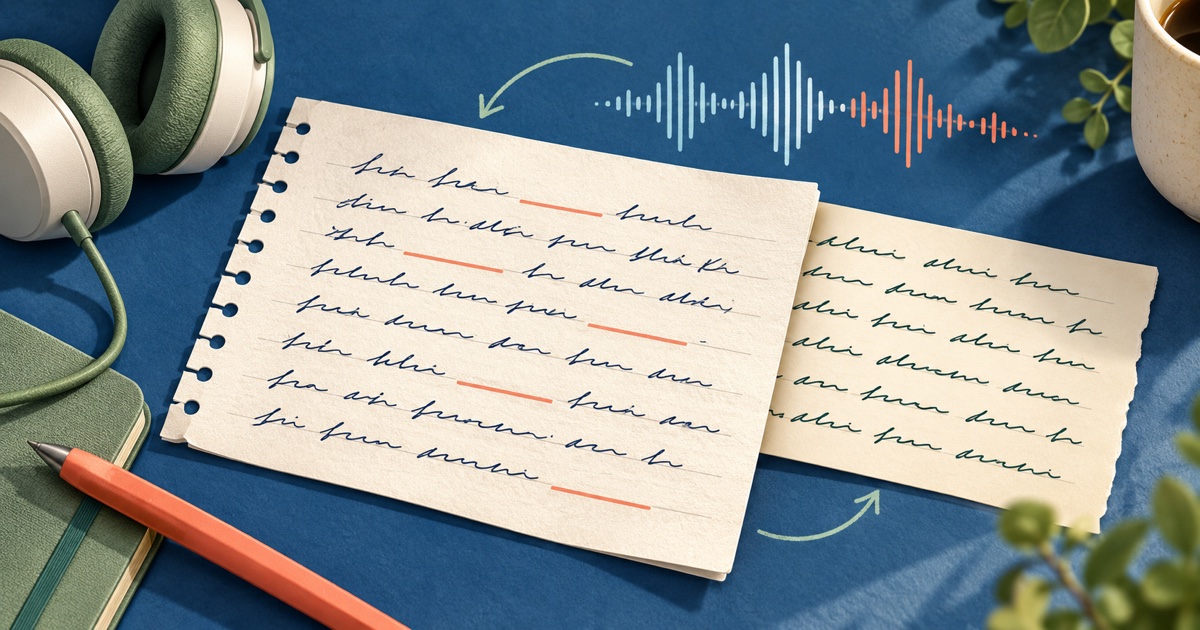
The short answer
Choose a short recording in the language you are learning, listen before you look at any transcript, and write down what you hear. Then compare your attempt with an official transcript if one is available; otherwise, a local speech-to-text draft can help you find passages to review, but it is not an answer key. Repeat the difficult section and sort out whether the gap came from sound, vocabulary, spelling, or grammar.
Why dictation is useful across languages
Dictation asks you to connect connected speech with words on a page. It can reveal that you know a word when you see it but do not recognize it in fast speech, or that a familiar phrase sounds different when a speaker links the words together. The same exercise can be adapted to English, Spanish, Japanese, Korean, French, or another language: the target language and the learner’s reading language change, but the listening-and-checking routine stays similar.
Use a short passage with one clear speaker and a topic you can mostly follow. A one- or two-minute segment is often easier to review than a full lesson. Beginners can choose slower, familiar material; advanced learners can work with natural speed, contractions, or less familiar vocabulary. The goal is a useful challenge, not perfect transcription on the first try.
Choose a recording that is challenging but workable
Pick a passage with a clear purpose: a short lesson explanation, a dialogue, or a section of a podcast whose subject you already understand. The recording should contain enough unfamiliar speech to stretch your listening, but not so much new vocabulary that every sentence becomes a guessing exercise. Start with one speaker and steady audio. Save rapid interviews, background music, and overlapping conversation for later practice because they make it harder to tell whether a missed word came from language knowledge or the sound itself.
Keep the passage short enough to repeat without losing the wider context. If the source is a long class recording, choose one section that covers a single idea. Write down the start point or a heading so you can return to the same segment next time. A consistent source also makes it easier to notice progress without claiming that one transcript measures your overall level.
Listen and write before revealing text
If the lesson provides a transcript, keep it closed for the first attempt. Play a short section once without pausing and write down the main idea. On the next pass, pause after a sentence or phrase and write the words you can identify. Mark uncertain sounds with a blank or a question mark rather than guessing and forgetting which parts were uncertain.
When no official transcript is available, Alison Workspace can create a draft transcript from a readable audio or video file. Import only material you are allowed to process. Choose the spoken language when you know it; automatic language detection depends on a compatible local Whisper model being ready. Required model resources may need to be downloaded before use. The product currently requires macOS 15 or later and an Apple-silicon Mac (M1 or newer).
To preserve the exercise, do your first listening and writing before opening the generated text. The app does not grade your dictation or automatically create a language-learning worksheet.
Compare in a way that teaches you something
After the first attempt, compare it with the course’s reviewed transcript when available. If you use a speech-recognition draft, treat it as a clue, not the official wording. Find the time around a disputed phrase, replay it, and check the source audio yourself. A draft may be wrong for the same reasons a learner’s first attempt is wrong: an unclear ending, an unfamiliar name, or speech that blends together.
Classify each missed item before correcting it:
- Sound: you did not hear a reduced syllable, linked consonant, or word boundary.
- Vocabulary: you heard the sounds but did not know the word or expression.
- Grammar: you recognized the words but missed an ending, particle, or agreement marker.
- Writing: you understood the phrase but were unsure how to spell or punctuate it.
This makes the next practice session more focused. If most mistakes are sound-related, replay a smaller section. If they are vocabulary gaps, add a few expressions to your study list with the original sentence. If spelling is the issue, check a dictionary or the course material rather than relying only on automatic recognition.
Use the recording and transcript together
For a file you are permitted to use, Alison Workspace’s transcription view can keep recognized text associated with the media timeline. Search or select a phrase, replay the corresponding passage, correct the transcript if necessary, and export a text format suited to your review. The speech-to-text output is a draft: names, numbers, quiet speech, accents, music, and overlapping voices need extra attention.
Video formats such as MP4 or MOV are containers, so an extension alone does not guarantee that a particular file can be read. The source needs an accessible audio track and a decodable format. If a file has no audio, is damaged, or uses an unsupported audio path, the transcript may be empty, partial, or unavailable. Keep the original recording and check its status before treating a result as complete.
After checking the transcript, replay the same short passage once without reading. Try to hear the phrase as a complete unit, then say it aloud if speaking practice is part of your goal. The app does not evaluate your pronunciation; use a teacher or a trusted pronunciation reference when that feedback matters.
Keep a small, reusable study record
Do not turn every transcript line into a vocabulary list. Choose three to five items that matter for your level or current lesson: a phrase you missed, a useful collocation, a grammatical ending, or a natural way to ask a question. Save the original sentence, a brief meaning note, and your own example. Record the time in the media if you want to find the sound again.
On a later day, listen to the same passage without looking at your notes. If you understand it more easily, move to a new passage; if not, isolate the one phrase that remains difficult. Reusing a short passage over spaced sessions is often more manageable than repeatedly transcribing a whole lecture.
Turn recurring errors into the next practice goal
After a session, count patterns rather than judging the whole attempt as “good” or “bad.” Did you miss reduced vowels, plural endings, particles, word boundaries, or unfamiliar collocations? Choose one pattern for the next passage and keep a short example that shows it in context. A learner of English might focus on connected speech; a learner of Japanese might check particles or verb endings; a learner of Spanish might notice unstressed syllables or verb forms. The exact focus depends on your level and course.
On the next day, listen once without text and see whether the target pattern is easier to hear. Then move to a different sentence with the same pattern. This turns the transcript into a review aid rather than a score. If a recurring error affects a formal assignment, ask a teacher or consult a trusted grammar reference instead of treating automated speech recognition as a language authority.
Choose a transcript source you can trust
A teacher-reviewed or publisher-provided transcript is usually the better reference for a class. Automated recognition can help locate likely wording when none is supplied, but it can miss accents, disfluencies, punctuation, names, and language-specific spelling. If a word affects an assignment or a formal citation, check the course material or ask the instructor.
Follow the recording owner’s terms, course rules, and applicable privacy requirements. Local processing does not grant permission to copy, retain, or redistribute protected audio. Alison Workspace’s file workflow processes media on the Mac after the required recognition resources are ready; exported transcripts are separate files and may be stored or synced wherever you choose to save them.
Frequently asked questions
What is a good language dictation exercise for beginners?
Start with a short, clear passage on a familiar subject. Listen once for meaning, then write one sentence or phrase at a time. Compare your work with a reviewed transcript and replay only the parts that were difficult.
Can I use an automatic transcript as the answer key?
Use it as a draft, not an authority. Recognition may mishear unfamiliar words, accents, names, or endings. Prefer an official transcript when available and replay the original audio before correcting a disputed phrase.
Can Alison Workspace transcribe a language lesson recording on Mac?
It can transcribe a readable audio or video file on a supported Apple-silicon Mac running macOS 15 or later, once the required language resources are ready. A specific file must contain accessible, decodable audio; the filename extension alone does not guarantee compatibility.
Should I choose a language or use automatic detection?
Choose the spoken language when you know it, especially for a short or clear lesson. Automatic detection requires a compatible local Whisper model and can still make mistakes. Review the output against the recording either way.
Does dictation practice work for languages with different writing systems?
Yes, but adjust what you check. A learner may focus on word boundaries, tones, endings, particles, accent marks, or character spelling depending on the language and lesson. Use trusted course materials for orthography and grammar.
Does Alison Workspace score my listening or pronunciation?
No. It creates a speech-recognition transcript for review; it does not grade your dictation, language level, or pronunciation. You can compare your own notes and use feedback from a teacher or trusted learning resource.
Can I use a movie or course recording for dictation?
Use only material you are allowed to process, and follow its copyright, course, and privacy rules. A locally processed file is not permission to copy or distribute the transcript or source recording.